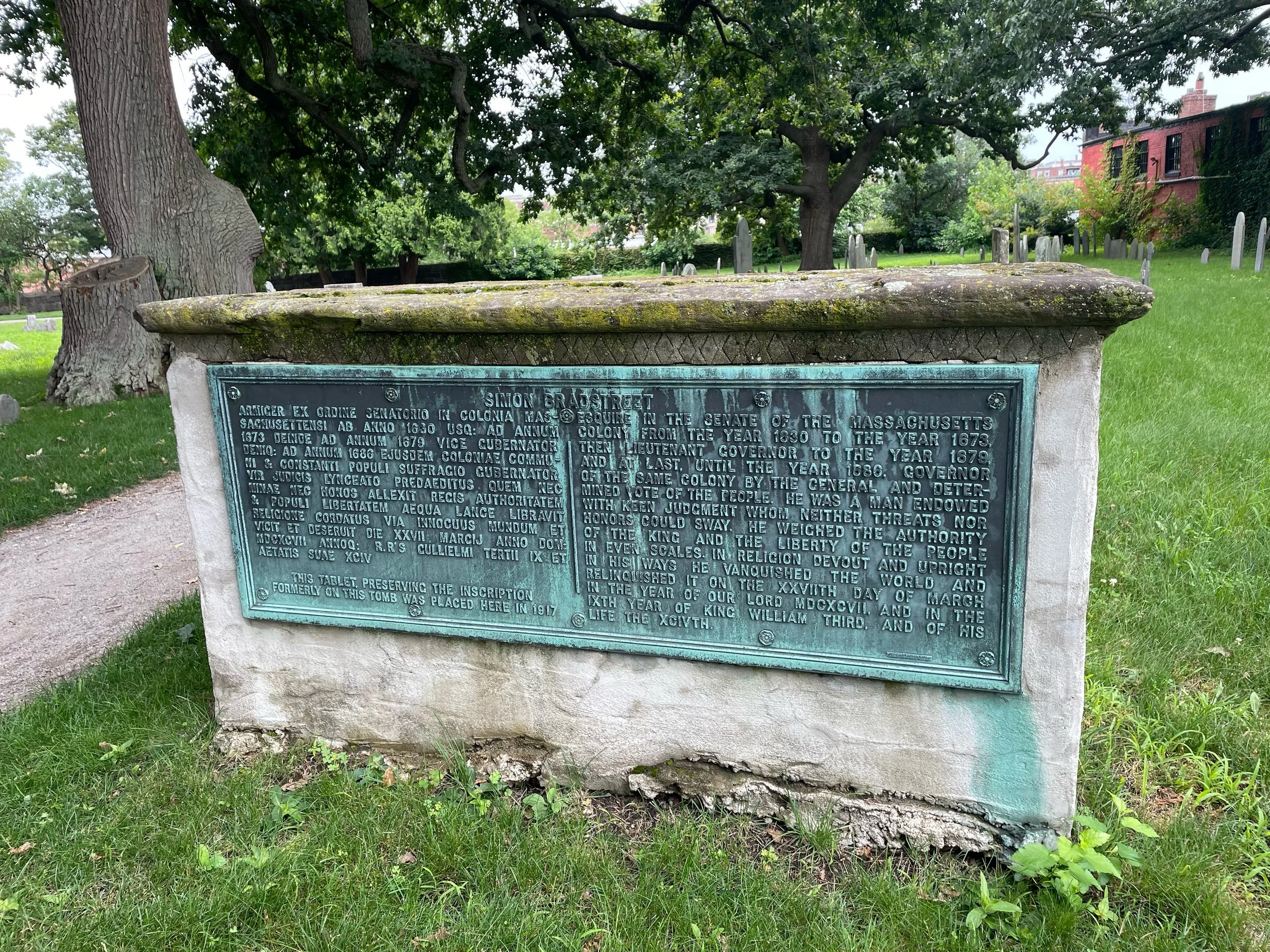
Simon Bradstreet, one of the most influential politicians in Massachusetts colonial history, was born March 18,1604 to Rev Simon and Margaret Bradstreet in Lincolnshire, England. His father died when he was 17 and he spent a significant portion of his teen years in the home of Thomas Dudley, a military man in service to the Earl of Lincoln as a steward. Simon attended Emmanuel College, where his father had been a Fellow, and received a Bachelor's degree in 1620, followed by a Masters in 1624. After graduating he entered the employ of the Earl of Lincoln alongside his mentor Dudley. The Earl was a known Puritan sympathizer and many early meetings of what would eventually become the Massachusetts Bay Company took place at his seat of Tattershall Castle. It was through these connections that Simon Bradstreet would find himself on the Company’s voyage to New England, alongside the 16 year old daughter of Thomas, Ann Dudley, who he married in 1628.
Arriving in the Arbella (named for the Earl of Lincoln’s daughter) in June of 1630, Simon found himself immediately in government, becoming the first ever Secretary for the colony. His father-in-law, Thomas Dudley would serve as Deputy Governor and later Governor, footsteps Simon would eventually follow in. Badstreet spent only about a year in Salem before moving to Cambridge, although he would soon move to Andover and later Ipswich. Despite his distance from the seat of power in Boston, Simon remained active in government, serving as first commissioner to the United Colonies, alongside William Hathorne. In 1661, Bradstreet was sent to England to congratulate Charles II on the restoration of the Monarchy and to negotiate the rights of Massachusetts. He returned with largely favorable terms, with the colony’s rights respected as long as it allowed more tolerance to Anglicans and surrendered those that had participated in the regicide of Charles I. New England stalled on any formal response to these demands.
At this same time, Simon’s wife Ann was making a name for herself, with her poetry being published in London and gaining a sizable readership in England and America. Considered to be America’s first published poet, Ann had an extensive library and literary output, alongside raising eight children around her ill health and husband’s frequent absence. She died in 1672 and her burial location is not currently known. A few years after her death, in 1676, Simon married the widow Ann Gardner, whose husband had been killed fighting the Narangansett six months earlier in the bloody violence of King Philip’s War. Bradstreet would return to Salem that year, moving into her large house located where Plummers Hall now stands.
Bradstreet was a very popular political figure in Massachusetts, serving as Deputy Governor from 1672-1679 and Governor from 1679 till 1685. He was seen as a moderate, advocating for a peaceful relationship with the English government. Despite his calming influence, the colony’s Charter was revoked in 1685 and a new Royal Governor was appointed (the interim governor was staunch Royalist and Simon’s brother-in-law Joseph Dudley). After the overthrow of the Royal government, Simon was elected once again, this time President of the Committee of Safety, and held this position until resigning in 1692 once Sir William Phips was appointed governor.
After leaving government, Bradstreet mostly led a quiet life. He seems to have at least publicly avoided entanglement with the Witch Trials, although his son Dudley oversaw examinations in Andover, despite considering himself extremely unqualified. Simon Bradstreet would pass away in 1697 at 93 years old, referred to by some as the “Nestor of New England” due to his age. A tomb was built for him at public expense and 100 pounds was allocated to his funeral by the colony. As the inscription on his tomb wore away, it was replaced with a metal plaque, including an English translation.