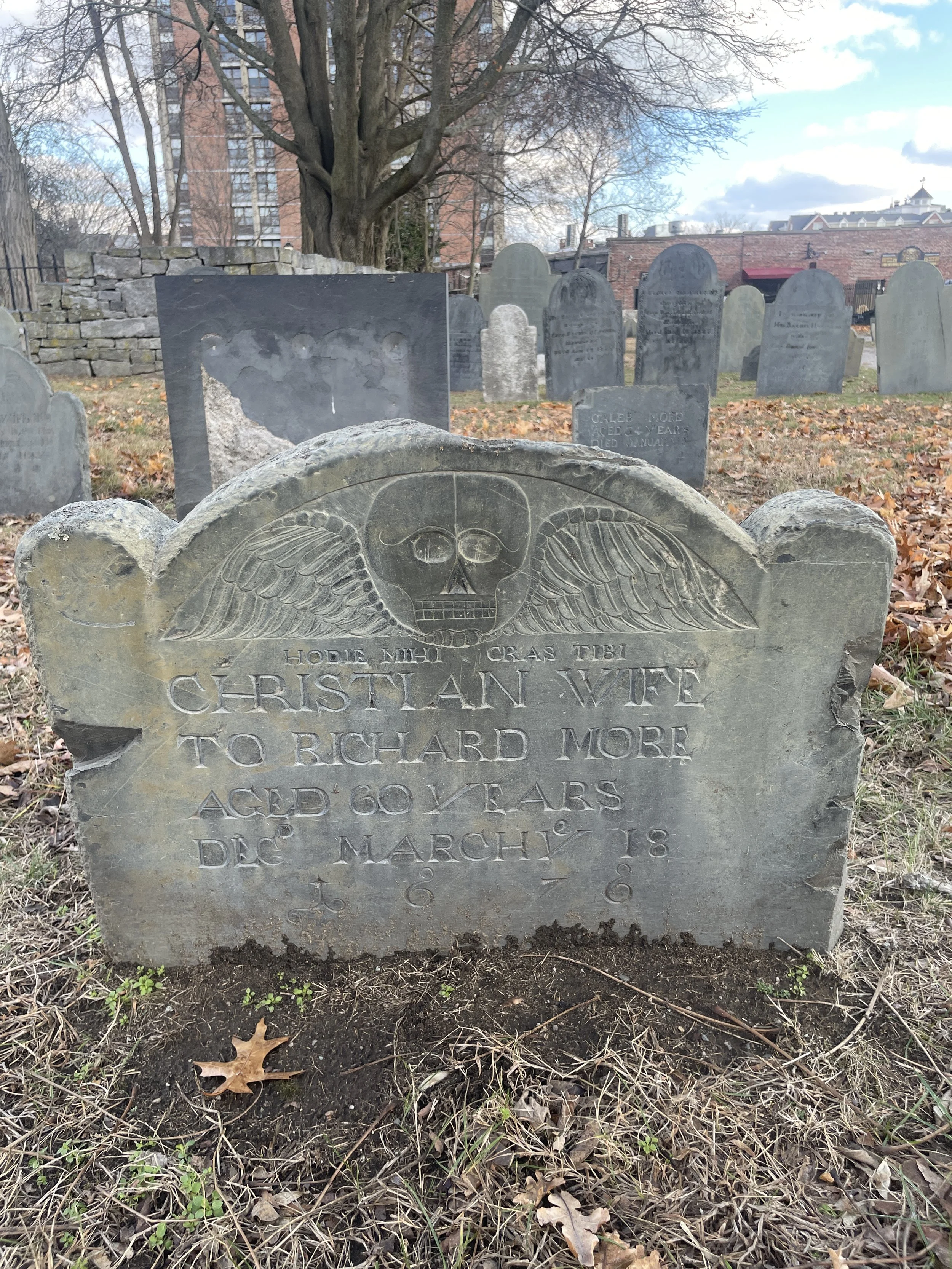
One of the oldest stones in Charter Street Cemetery belongs to Christian More, first wife of Mayflower Passenger Richard More. As is common among many of those who came to New England in the early 17th century, a good deal of Christian’s early life is a mystery. Born Christian Hunter in 1615, she would marry Richard More shortly after her arrival in New England, an arrangement that might have had more to do with practicality than general affection. Both of them were relatively young and do not appear to have spent a great deal of time together in the early years, but marriage would have been necessary for Richard to claim the land he was owed down in Plymouth. They did have things in common: both of them had come to New England with foster parents and hers was a former employer of Richard. Christian would not have children for the first five years of their marriage (Richard would have one in England, but Christian was not involved), but after giving birth to twins, Samuel and Thomas, in 1642, they would go on to have five more children over the next ten years.
Despite Richard’s business and personal life often skirting legality, Christian seems to have maintained a respectable lifestyle despite him, becoming a member of Salem’s church in 1650 and managing Richard’s business interests while he was away at sea. In 1676, Christian would pass away, sparing her the indignity of witnessing her husband's eventual prosecution for fornication and adultery. She was buried near their house on Charter Street, in the More family plot located in what at the time was the northeast corner of the cemetery. Her 34 year old son, Caleb, had been buried there the previous year. Three years later, Richard would receive permission to fence in their graves “fourten foot in length & about ten fott in breadth.” He would join them in that plot in about 1696.
Christian’s grave is a classic New England stone, with a traditional and very prominent Death’s Head and stylized numbers for the date. In true Puritan fashion, her stone bears the Latin inscription Hodie Mihi Cras TIbi (Today for me, Tomorrow for you)