Gedney is perhaps the least well-known of Salem’s Witch Trial judges, but he was arguably one of the most important members of the court. While shipbuilding was his initial trade, he served at various times as a Deputy, a clerk, or a magistrate on the local courts. He would additionally be put in charge of fire management, the construction of a new jail, acted as one of its few practicing physicians, and would eventually command the Essex militia. Gedney’s social standing made him an ideal candidate to be one of the first admitted to Salem’s church under the controversial new Halfway Covenant. His business interests were varied, not only being a shipbuilder and licensed retailer of ‘strong water’, but owned a tobacco house, a still house, a hot house, and a wharf on Winter Island. As Sidney Perley notes, he “must have presented a fine appearance on his horse, with his velvet saddle, holsters and trappings, trimmed with silver, and his belt wrought with gold.”
While a clear example of the New England elite, Bartholomew Gedney’s political popularity suffered in the 1680s. As the King made moves to nullify the Massachusetts government, Gedney was one of those politicians who advised surrendering the Charter to the King without a fight, which alienated him from the larger Puritan voting bloc. In 1685, along with other Royalist-leaning candidates, Gedney was not elected to the Court of Assistants, causing the resignation of like-minded William Stoughton. This faction’s exclusion would be short lived: that same year the Charter was revoked, its government dissolved, and Gedney and Stoughton would be appointed to the new Crown-approved government. However, the new royal governor was intensely unpopular and when he was overthrown in 1689, Bartholomew Gedney would serve on the Committee of Safety that overthrew him. While he was again not elected to the Council in 1691, Gedney would nevertheless be appointed to that position by the new Governor, Sir William Phips.
When the Witch Trials began, Gedney was an obvious choice to serve on the court (its Chief Justice being his political ally, William Stoughton). Of the nine judges that made up the Court of Oyer and Terminer, only five of them were required to be present at any one case, so long as one of them was Stoughton, John Richards, or Bartholemew Gedney. Gedney is largely absent from examinations early in the year, but once he appears in the records a few months later, his name is almost always listed first. Despite the subsequent backlash against the Trials, Gedney’s prominent role does not appear to have disadvantaged him. He was appointed to the Probate Court in 1693 and served as a military officer under the new Governor, William Stoughton. He is buried with three of his children and his first wife, his second wife being buried in Ipswich.
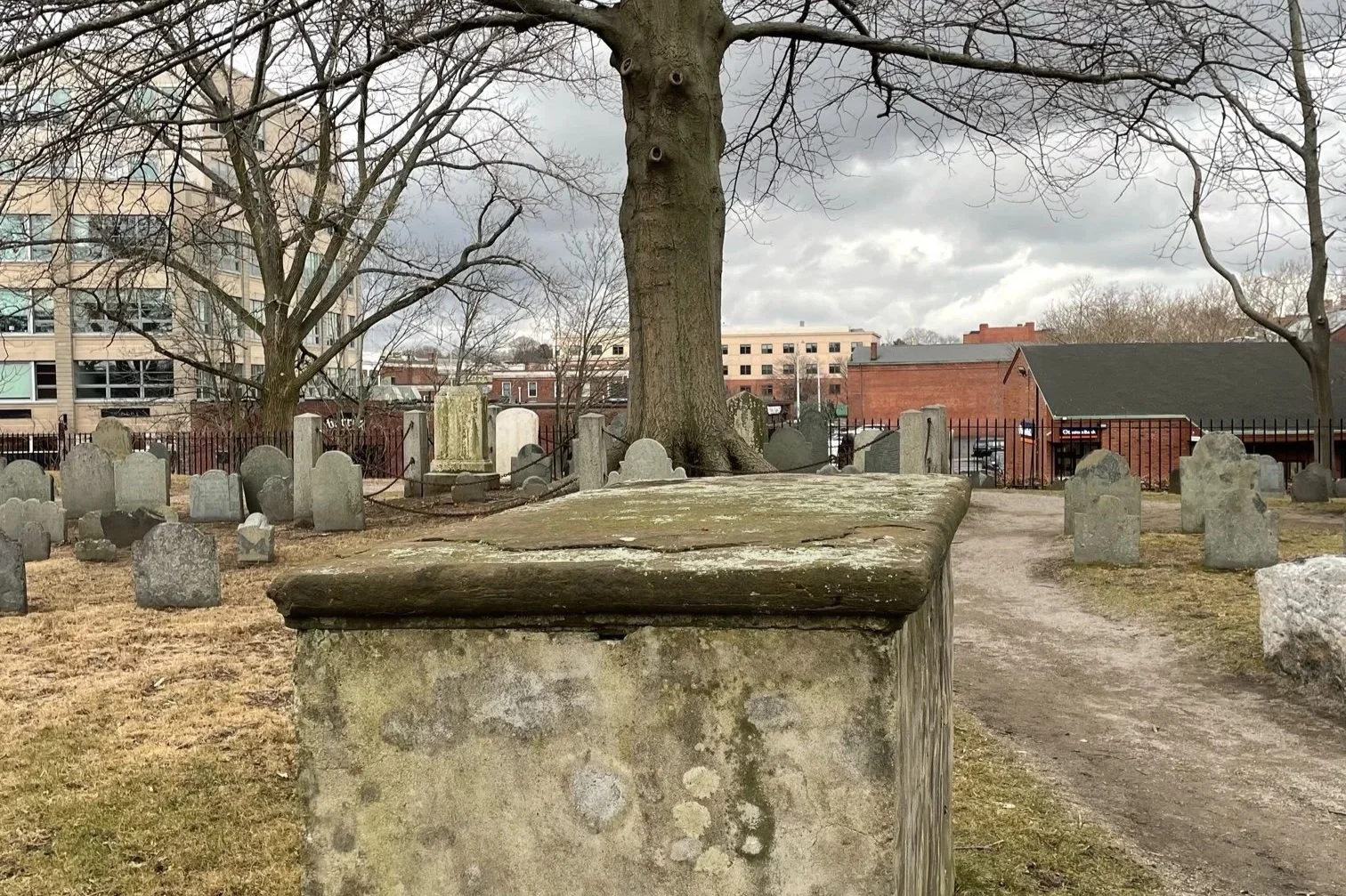
The top of the Gedney tomb is actually much younger than the tomb itself, being repaired as part of larger renovations in 1894. However, due to the soft sandstone and frequent interactions over the years, it is far more difficult to read than many older stones.